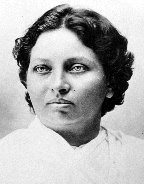
Pandita Ramabai Photograph
1 media/Pandita Ramabai_thumb.jpg 2026-07-24T12:04:12+00:00 Amardeep Singh c185e79df2fca428277052b90841c4aba30044e1 184 1 Pandita Ramabai Photograph Pandita Ramabai Photograph plain 2026-07-24T12:04:12+00:00 Amardeep Singh c185e79df2fca428277052b90841c4aba30044e1This page is referenced by:
-
1
2020-09-04T09:49:47+00:00
Literature of Colonial South Asia: A Digital Archive
57
British Raj Literature; Collection of Full Text Versions of South Asian and British fiction from the British Colonial Era (1850-1930)
plain
2026-08-15T17:52:14+00:00
This project is a collaboration between Amardeep Singh and Sana Asifriyaz.
Welcome! Here we have assembled a collection of works of literature by both Western and South Asian writers from the British colonial period. The focus of the collection is predominantly Anglophone works of literature -- fiction, poetry, and drama -- by authors between 1850 and about 1930, though there are some earlier materials as well as some post-1930 materials that are out of copyright. We are also including published translations from Indian languages, especially Bengali and Marathi. Some select nonfiction works are also included, especially when they were authored by writers who also wrote works of fiction and poetry.
A good place to start might be the chronological list of full-length books collected on this site.
Some of the topics we have been developing are:- Indian Writers in the West During the Colonial Period (1794-1947)
- South Asian Women Writers from the colonial era
- Fiction by Western Women in British India
- Writers associated with the Bengal Renaissance (and an overview of some key themes of the Bengal Renaissance)
- A collection of Rabindranath Tagore's short stories in translation
- Writers who responded to the 1857 Sepoy Rebellion (or Sepoy Mutiny)
- Writings dealing with interracial romance and the multiracial Anglo-Indian community
- Writers who described various famines of the British Raj
- Writers who described emerging social movements and anti-colonial politics
- Indian Revolutionaries in the U.S.: The Ghadar Party and the Young India Movement
- Detailed summaries of select texts collected on this site.
- Quantitative Approaches: Some Preliminary Comparisons of British and Indian Texts Using SpaCy and Stanza NER
The Google Drive version of this collection can be found here. You'll also find a metadata spreadsheet there with publication information. This project builds on earlier digital collections I have developed, including The Kiplings and India, and The Collected Poems of Henry Derozio.
1. What is in the Collection?
As mentioned above, British, American, and Canadian authors are included alongside South Asian writers in the present collection.
One reason to do this is that many of the writers were clearly in dialogue with one another; South Asian writers were clearly reading people like Rudyard Kipling, E.M. Forster, and Katherine Mayo. (For example, Dhan Gopal Mukerji, in Caste and Outcast, quotes directly from Kipling.) It's a little less clear which South Asian writers British and American writers were reading other than Rabindranath Tagore and Sarojini Naidu -- and this itself might be studied. The writer English Maud Diver, who published many novels set in India, rarely engaged with Indian authors early in her career, though she opens her 1921 novel Far To Seek with epigrams from Tagore. Forster, for his part, has Aziz and his friends reciting Urdu poetry by Mirza Ghalib and Iqbal
Publishing Houses: The publishing industries also overlapped to a considerable extent; while some South Asian writers published their works with publishers based in India, many aimed to publish with houses based in London. The Hogarth Press is particularly notable for publishing Ahmed Ali's Twilight in Delhi (1941) and G.S. Dutt's biography, A Woman of India (1929). It also published Edward Thompson's critique of one-sided accounts of the 1857 Sepoy Mutiny in The Other Side of the Medal. Quite a number of other Indian authors who published in the West used mainstream commercial publishing houses like Macmillan and Heinemann.
Moreover, the British Raj had its own English-language publishing houses based in India itself, such as Thacker, Spink, and Company and Stanhope Press. Thacker, Spink & Co. published some early volumes of Rudyard Kipling's. A.H. Wheeler's Indian Railway Library is another important publishing house; it started with several volumes by Kipling before expanding to a range of other authors. There was also an array of publishing houses publishing work in Indian languages. Thacker, Spink & Co. also published an English translation of Peary Chand Mitra's The Spoilt Child in 1893.
Points of Comparison: Historical Events, Comparative Geography. One possible line of inquiry with this material might be to try and compare fiction, poetry and drama by British, Irish, and North American authors with South Asian output in English. Such inquiry could either be historical and thematic (i.e., comparing the way British and South Asian writers reacted to historical events like the Sepoy Mutiny or the Famine of 1876), or it could be connected to matters of language and style. To do that it makes sense to have writers from different backgrounds represented in the Corpus. Another topic of interest might be the comparative geographies of the South Asian experience for the two communities of authors. What settings or locales tend to appear most often, either within the scope of any given town or city, or with respect to the Indian subcontinent as a whole? Do Western writers in India describe a range of locations that is broader than those described by writers who were South Asian?
North American writers. There was also a fair amount of interest in colonial India in the U.S. and Canada at the time -- from the appreciation of Kipling to the American feminist fascination with Pandita Ramabai. In the 1920s, a major figure might be Katherine Mayo, whose scathing book Mother India provoked a considerable outcry from many Indian writers shortly after it was published. Readers may be less familiar with the pulpy Indian adventure novels by an American writer named Talbot Mundy. Perhaps the writer of greatest interest to scholars today might be the Canadian writer Sara Jeannette Duncan (several of her works are in our collection here).
In the metadata file, we list the nationalities of the authors. Besides the North Americans in the collection, I would draw readers' attention to B.M. Croker--an Irish woman who lived in India and wrote many Romance novels based in colonial India.
In addition to the nationality question, with South Asian writers who moved abroad there is also the question of destination. Cornelia Sorabji (who eventually moved to England) is of course pretty well known. Dhan Gopal Mukerji, who moved to the U.S. in the 1910s, is mainly known for his memoir Caste and Outcast, but he was quite a prolific literary writer, with several books of poetry and fiction that are worth looking at. See our page collecting writings by Indians who traveled in the West.
2. Translations.
We decided to include translations by South Asian writers like Bankim Chandra Chatterjee (Chattopadhyay) and Rabindranath Tagore (Thakur) in the Corpus where we could find editions that were out of copyright (see the list of texts on the Bengal Renaissance page). Tagore of course needs no explanation; he was one of the few South Asian writers to break through and achieve global acclaim in the early 20th century. Bankim Chandra Chatterjee (here, I'm using the Anglicized spelling most commonly used at the time in English) is slightly different. He is clearly historically important for Anandamath (here included in translation as Dawn Over India) and Rajmohan's Wife (thought to be the first English-language novel by an Indian author), but it seemed like it might be valuable to include some other of his Bengali novels in translation here. See our Bengal Renaissance page for more. Several of these translations are available from Wikisource.
Alongside translations by South Asian writers, there are a few translations in the corpus of historical South Asians texts by British writers.
3. Fiction and Nonfiction
Right now there is a limited amount of nonfiction included in the corpus. This was a tough decision, as there is a vast array of nonfiction colonial travel writing based in South Asia from this period. We have excluded most of that sort of writing for now.
However, we are including some nonfiction, mostly texts by literary authors who wrote occasional works of nonfiction (Dhan Gopal Mukerji's Caste and Outcast is included, as is Tagore's My Reminiscences). We have also included a plain text file of Pandita Ramabai's The High-Caste Hindu Woman, mainly because it seems like an important text that might be useful for researchers in this field. Another important nonfiction text might be Edward Thompson's The Other Side of the Medal. Any queries specifically structured around the stylistics of fiction or other quantitative textual analyses might want to exclude these nonfiction texts.
4. Derivation; proofreading work
The texts included here have been pulled together materials from different repositories to assemble this corpus. Here, the lion's share of material comes from Project Gutenberg and HathiTrust. The Gutenberg materials were in good shape; they've generally been proofread and formatted cleanly. The HathiTrust materials have required much more work. One can extract HathiTrust texts by requesting plain text, but these OCR page scans need quite a bit of processing to make them clean enough to use. A lot of the grunt work of assembling this collection has entailed doing that processing.
A number of the texts on this site have also been derived from The Veranda, an excellent collection of texts by mainly Western authors who wrote about India under British colonial rule. We are grateful to the editor of that project, Janusz Buda, for permission to use his formatted and proofread versions here.
- Chronological List Of Full-Length Texts On This Site
- South Asian Women Writers
- Writers of the Bengal Renaissance: an Overview
- Rabindranath Tagore's Short Stories (a collection)
- Fiction by Western Women in Colonial India
- Literature of the 1857 Mutiny / 1857 Rebellion
- Indian Travel Writers in the West: the Colonial Period (1794-1947)
- Interracial Romance and Multi-racial Anglo-Indian Community
- Emerging Social Movements and Nationalist Politics
- Representations of Illness and Famine
- Detailed Summaries of Texts on this Site
- Tag Cloud and Network Visualization
- Quantitative Approaches
-
1
2026-06-17T14:04:49+00:00
South Asian Women Writers
25
Profiles of South Asian Women Writers, such as Sarojini Naidu, Cornelia Sorabji, Pandita Ramabai
plain
2026-07-28T14:51:20+00:00
This collection features a number of writings by South Asian women in British colonial India.
First, one might note that in comparison to Western women writing about India, there are fewer authors on this list than there ought to be! Gender biases within South Asian families often led to young women remaining uneducated, meaning that most Indian women during the British colonial era were illiterate. Even those who did receive educations often struggled for full professional parity with their male peers (Many of these barriers were also of course in place in England as well: Cornelia Sorabji had to wait 25 years after studying Law at Oxford to receive her formal degree as a Barrister.)
One interesting pattern with the list of Indian women whose works we have been collecting is that many of them grew up in families of Christian converts, or converted themselves. This is true for Cornelia Sorabji (her father was born a Parsi but converted), Pandita Ramabai (who converted as a young adult), and Krupabai Sattianadhan.
A second pattern to note might be that two of the women whose works are collected here died quite young of tuberculosis: Krupabai Sattianadhan and Toru Dutt both fell victim to the disease; one can only speculate what they might have gone on to write had they lived longer.
Finally, it's striking that several of the women whose works are included here were not simply interested in careers as "writers"; they were active reformers who built important institutions, some of which persist to this day (Rokeya Hossein founded a school for girls; Pandita Ramabai founded a school for child widows, Shardi Sadan; Cornelia Sorabji was a tireless reformer and advocate for women; Sarojini Naidu became quite active in the nationalist movement and joined the Indian National Congress; beginning in 1941, she spent 21 months in prison for her participation in the Quit India movement).
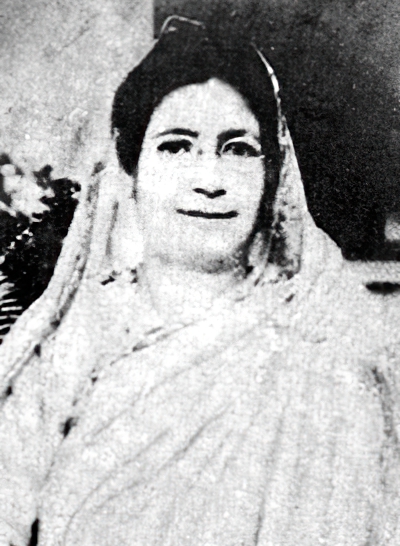
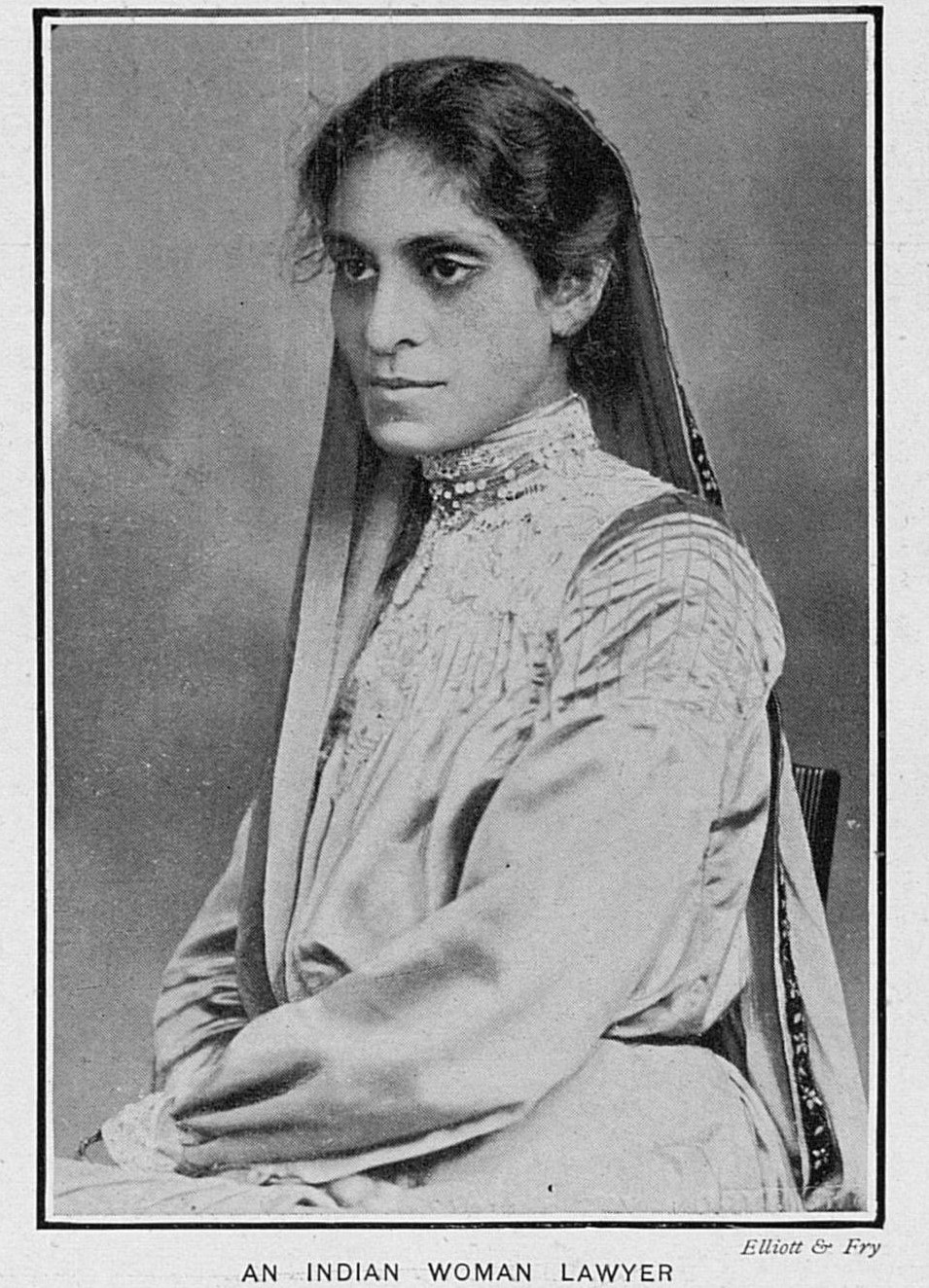
Some of these names may be familiar to readers. Cornelia Sorabji, for example, achieved considerable success and was highly visible in her time, as the first Indian woman to be granted a law degree, and because of her extensive social and reform oriented work on behalf of Indian women. (Among other things, she frequently represented Purdahnashins -- women who were 'behind Purdah' [women living in segregation, who did not generally appear in public] -- in questions of property and civil law.) Sorabji wrote many books, though most were nonfiction.- Her first book, a collection of short stories called Love and Life Behind the Purdah (1901) is in our collection, as are detailed summaries of the stories.
- In 1908, Sorabji published a book called Between the Twilights. This is essentially an ethnographic account of women in Hinduism. It features profiles of some important Hindu deities (Saraswati, Durga, Kali) with an emphasis on rituals and practices associated with them. Many of the anecdotes have a personal touch: Sorabji describes her own visit to a Kali temple, a conversation with a grandmother, etc. Sorabji also addresses topics like the plight of Hindu widows, the confusion and sense of displacement felt by "western returned" women, and the deep and powerful role played by caste in Indian life. In the final chapter, she gives some examples of difficult cases she had encountered representing "secluded" women in property and inheritance cases in rural India. A detailed summary of the book can be found here.
- We also have a version of her 1918 book Sun Babies: Studies in Colour here (first published as Sun-Babies: Studies in the Child-Life of India in 1904). There is also a detailed summary of the book here.
- We also have an edition of her 1934 memoir, India Calling, where she describes her hybrid upbringing -- with her family's Parsi heritage but Christian identity and her legal career, with many colorful accounts of representing poor women in legal cases in Princely states. She also expresses her ambivalence about the Indian nationalist movement; in contrast to Sarojini Naidu (described below), Sorabji never joined the Indian National Congress. While she was initially supportive of the nationalist movement, by the late 1920s, she had rejected the movement and instead embraced the continuation of British rule in India. The full text of the memoir is here, and a detailed summary of it is here.
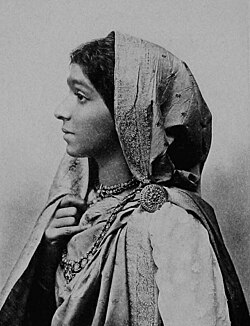
Sarojini Naidu was also quite prominent in her time, though in recent years her work has received less attention from scholars than it likely deserves. Her first book of lyric poetry, The Golden Threshold, was published in London in 1905 -- before Tagore's Gitanjali -- and contained a portrait of the author as a teenager by John Butler Yeats. Another book of poetry, The Bird of Time (1912), shows greater maturity and engagement with modern, urban life in India. It also contains a few poems with an emerging nationalist sensibility. The embrace of socially engaged poetry comes into full flower with Naidu's third book, The Broken Wing (1917). That latter collection contained a poem honoring Indian soldiers who fought for the British in World War I, as well as a poem dedicated to Mohammed Ali Jinnah ("Awake!"), which Naidu recited at the meeting of the Indian National Congress in 1915. There is also a poem dedicated to M.K. Gandhi (not yet "Mahatma"). After 1917, with her increasingly direct involvement in the activities of the Indian National Congress, Naidu published less poetry, though she came to play a key role in the protest and organizing activities of the Indian nationalist movement.
More recently, Rokeya Sakhawat Hossain's Sultana's Dream -- a feminist utopia -- has been rediscovered, becoming a celebrated and widely read text, often assigned as an early instance of a feminist utopia. (The conceit of Sultana's Dream is a reverse Purdah -- where men are forced to live in a segregated part of the household [the 'Mardana']. Hossain also explores and challenges many misogynist stereotypes and tropes (I.e., men have bigger brains so they must be more intelligent). Hossain also wrote a good number of other works of literature, most of them in Bengali. Some, like Padmarag, have been translated into English and are now receiving attention and interest from scholars.
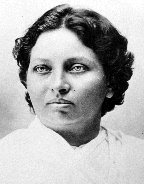
Pandita Ramabai is a well-known feminist reformer, and relevant to this collection, though she only wrote nonfiction. After many of her family members died during the Madras famine of 1876-78, she and her brother found their way to Calcutta. There she was noticed by scholars and drawn into contact with Christian missionaries. The missionaries arranged for her to be sent to England, where she formally converted to Christianity. After a brief stay in England, Ramabai toured the United States extensively before returning to Maharashtra to start a school and social support network of widowed women. Several of her texts are included in our collection. Also see our detailed author profile of Pandita Ramabai here.
And readers may also be familiar with Toru Dutt, a poet who was largely raised in England and France. She published quite a bit in a life cut short by tuberculosis. We have Ancient Ballads and Legends of Hindustan in our collection.
However, there are some other writers whose works will be featured here who may be less familiar. One such is Krupabai Satthianadhan, who grew up as a Christian in southern India after parents had converted. Though initially she was not formally enrolled in school, she benefited from the support of a brother who supervised her education. Her novel Saguna, A Story of Native Christian Life is thought to be essentially an autobiography; see a detailed summary of it here. -
1
2026-07-05T15:08:44+00:00
Pandita Ramabai (1858-1922): Author Profile
2
Author Profile for Pandita Ramabai, also known as Pandita Ramabai Saraswati, Ramabai Dongre
plain
2026-07-27T20:44:19+00:00
Pandita Ramabai (1858-1922) was a social worker and reformer, who is known widely today in India as a feminist pioneer. She lost her father, mother, and sister in the Madras Famine of 1876-1878, which is thought to have killed 10 million people.
Though she was born and raised in the southwestern state of Maharashtra, after her parents died, she and her brother found their way to Calcutta in 1878, where she was briefly married to a Bengali lawyer who subsequently passed away. The marriage created social obstacles for her, as Ramabai was born a Brahmin but her husband Bipin Behari, was from the Shudra caste. As a young woman who was deeply knowledgeable about Sanskrit Hindu texts -- which she had learned about from her father -- she was already poised to be an influential figure. (In traditional Hinduism, women were excluded from knowledge of scriptures.) Pandita is, to be clear, not actually her first name; it’s an honorific she received after proving her knowledge of Sanskrit scriptures to a group of Sanskrit scholars at the University of Calcutta. It seems important to note that she continued to use this name, and publicly identify herself as “Pandita Ramabai,” even after converting to Christianity (her Christian name upon Baptism was “Mary Rama”).
Ramabai’s brother died in 1880, and her husband died in 1882, leaving her to raise her daughter Manorama on her own.
In 1883, Ramabai traveled to England to study and teach; it’s thought that she only seriously began to study English at this time. Initially she had planned to study medicine, but was forced to drop out because she had imperfect hearing. Shortly thereafter, she converted to Christianity and taught Indian languages to the Wantage sisters in England. In 1886 she came to the U.S., and stayed for two years, giving lectures, meeting with women’s groups, and aiming to call attention to the situation of Indian women. Her most influential book was a critique of the status of women in Hinduism, called The High-Caste Hindu Woman (1888); she wrote that book in English -- it was aimed at western feminist readers. She published The Peoples of the United States (1889) specifically for Indian readers.
Scholars have been particularly interested in the role of religious conversion in shaping Ramabai’s thought. For a generation of Indian readers, her conversion to Christianity and her championing of women’s rights seemed to suggest a kind of self-hatred. There was a suspicion that her feminism came from external influence, and that her Christianity might have been only a strategic ploy to gain patronage from wealthy Christian benefactors:
The conservative Hindu skepticism was voiced in The Mahratta’s (4 November 1883) cynical assertion that “the learned lady has deceived and disappointed alike her friends and foes” and “enrolled herself into the charitable clan of Christ” for monetary reasons. In her subsequent writings Ramabai herself explained her conversion as a natural outcome of her spiritual quest and intellectual conviction (Ramabai [1907] 1992: 26; Kosambi 1992). In any case, if Ramabai’s conversion resolved her spiritual tensions, it also created fresh problems. Her theological doubts and contestation of colonialism led to considerable friction with the Anglicans. (19)
But upon closer examination we see that her approach to both Christianity and feminism are more complex than one might expect. In her letters we see her frequently arguing with her English mentors -- the ones who brought about her conversion -- and pushing them on gender issues. Could it be that she used Christianity to support her feminism -- with her feminist commitments being primary and Christian faith secondary?
There are two letters from Ramabai’s published correspondence that might be helpful documents to look at as we might attempt to unpack Ramabai’s relationship to religion:It seems to me that you are advising me under the WE to accept always the will of those who have authority, etc. This, however, I cannot accept. I have a conscience, and a mind and judgment of my own. I must myself think and do everything which GOD has given me the power of doing. . . . Although priests and bishops may have certain authority over the church yet the church has another Master Who is Superior even to the bishops. I am, it is true, a member of the Church of Christ, but I am not bound to accept every word that falls down from the lips of priests or bishops. . . . Obedience to the law and to the Word of God is quite different from perfect obedience to priests only. I have just with great effort freed myself from the yoke of the Indian priestly tribe, so I am not at present willing to place myself under another similar yoke by accepting everything which comes from the priests as authorized command of the Most High. At the same time I am not willing to offend anyone or to do wrong. But can you or your friends prove that giving lessons to boys is a wrong thing?
(Ramabai in a letter to her friend and mentor, an Englishwoman named Sister Grenadine, May 12, 1885)
And here’s another letter expressing a very different sentiment:I beg of my Western sisters not to be satisfied with the looking on the outside beauties of the grand philosophies, and not be charmed with the long and interesting discourses of our educated men, but to open the trapdoors of the great monuments of the ancient Hindu intellect, and enter into the dark cellars where they will see the real working of the philosophies which they admire so much. Let our Western friends ... frequently go to the hundred of sacred places,... Jagannathpuri, Benares, Gaya, Allahabad, Mathura, Brindaban, Dwarka, Pandharpur, Udippi, Tirupaty and such other sacred cities, the strongholds of Hinduism, and seats of sacred learning, where the Mahatmas and Sadhus dwell, and where the ‘sublime’ philosophies are daily taught and devoutly followed. There are thousands of priests and men, learned in the sacred lore, who are the spiritual rulers and guides of our people. They neglect and oppress the widows and devour widows’ houses.... They send out hundreds of emissaries to look for young widows and bring them by hundreds and thousands to the sacred cities to rob them of their money and their virtue.... Thousands upon thousands of young widows and innocent children are suffering untold misery and dying helpless every year throughout the land, but not a philosopher or Mahatma has come out boldly to champion their cause and to help them .... The educated men and learned priests... mourn over a few women who have the boldness to declare themselves as free women and to follow their conscience; but they say nothing of the thousands who die every year or lead shameful lives.... Let not my Western sisters be charmed with the books and poems they read. There are many hard and bitter facts we have to accept and feel. All is not poetry with us. The prose we have to read in our lives is very hard. It cannot be understood by our learned brothers and comfortable sisters of the West. (1894. Letters and Correspondence of Pandita Ramabai, pp. 312-314)
Scholars have been looking over those letters carefully and interpreting them, along with her other published books and essays, to try and answer those questions.
While in the U.S., Ramabai attracted quite a following from American women’s groups, who gave her substantial financial support for her plan to return to India to start a school for Hindu widows. In a number of cities, those groups formally came together and formed “Ramabai Associations,” which continued to raise money even after Ramabai ent home in 1888. The school opened and was successful, though Ramabai had some significant challenges in sticking to her initial pledge not to try and convert the young women enrolled in the school to Christianity.
She also opened a shelter for women called the Mukti Mission, in response to another terrible famine in India in 1896. That center housed and nourished hundreds of girls, though with a much more explicitly Christian and proselytizing framework.
In the last two decades of her life Ramabai published much less in terms of books and essays for public consumption, and instead worked on a Marathi translation of the Bible.
.jpg)