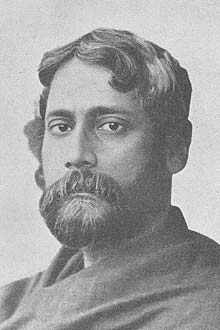
Rabindranath Tagore Photograph
1 media/Rabindranath Tagore photograph_thumb.jpg 2026-07-24T12:06:18+00:00 Amardeep Singh c185e79df2fca428277052b90841c4aba30044e1 184 1 Rabindranath Tagore Photograph plain 2026-07-24T12:06:18+00:00 Amardeep Singh c185e79df2fca428277052b90841c4aba30044e1This page is referenced by:
-
1
2026-07-23T15:35:17+00:00
Short Stories by Rabindranath Tagore: A Collection
39
A Collection of Short Stories by Rabindranath Tagore in English Translation
plain
2026-08-07T13:06:03+00:00
(See our Tagore Author Profile for links to more Tagore materials on this site.)
All told, Tagore published more than 100 short stories and novellas in his lifetime. He was especially prolific as a short fiction writer during the 1890s, sometimes referred to as his "Sadhana" period after the family magazine he worked on and edited (a bit more about that magazine here). His biographers Krishna Dutta and Andrew Robinson indicate that he wrote about 59 stories during this brief time period, including much-beloved classics like "The Postmaster."
English translations of the stories began to appear regularly starting in the 1910s, starting with a collection called Glimpses of Bengal Life, published in Calcutta in 1913. Shortly thereafter, four additional collections of translated short stories by Rabindranath Tagore were published in the 1910s and 20s: Stories from Tagore (1918), The Hungry Stones and Other Stories (1916), Mashi and Other Stories (1918), and Broken Ties and Other Stories (1925). These collections were all published by Macmillan in the United States and England; the various collections contain significant overlap in terms of the stories they contain.
Here, we are collecting translations all of the short stories by Tagore we can find, and adding thematic tags and summaries to aid researchers in finding interesting groupings. I believe this is the most comprehensive collection of Tagore's stories in translation currently available online, though there are a number of stories we have been unable to include since the translations are still in copyright. (The translations included below should all be out of copyright.)
At the Country Estate. Tagore was born and raised in Calcutta, but at the time he wrote most of his "Sadhana" stories he had just begun living at his family's country estate at Shilaidaha (then usually called "Shelidah" in English), in what is today Bangladesh. There, he performed landlord duties on his family's behalf, receiving payments from tenants, addressing complaints, and managing the estate. He is described by his biographers Krishna Dutta and Andrew Robinson as finding the experience of country life and ordinary people as an eye-opening experience, and the decade he spent living and working at Shilaidaha as one of the most fruitful ones for him of his entire career. Not surprisingly, many of the stories he wrote during this period play on what might be described as "country vs. city" themes, exploring the gap between urban and rural life, and the clash between traditional Bengali peasant life and modern, colonial India. Also, even as he was outside of Calcutta while writing most of these stories, many of the stories do engage with city living in Calcutta in interesting ways. Others are written from the point of view of Landlords (Zemindars) like himself.
Judges and the Justice System. While performing landlord duties at Shilaidaha throughout the 1890s, Dutta and Robinson describe Tagore as working with villagers to adjudicate their grievances and disagreements. He acted, in effect, as a kind of judge in a parallel legal system. Not surprisingly, questions of justice and jurisprudence show up in several stories from this period, including "The Riddle Solved," "The Sentence," "The Judge," and "Detective." In "The Riddle Solved," the son of a wealthy Zamindar decides to modernize his father's property management, and cuts off special privileges being given to a particular Muslim tenant. The tenant then attacks the son, and in the trial certain secrets are revealed. "The Sentence" is a tragi-comic account of marital drama and dysfunction in an extended family living on the edge of poverty. It has a dark edge, of course, as one of the characters murders another and an innocent young wife is asked to take responsbility. In this story, Tagore seems to be suggesting, true justice is elusive. (Translating this story is also particularly complex; see our note about that attached to the text of the story itself at the link above.) Justice is also elusive in "The Judge," which foregrounds the hypocrisy of men in powerful positions and double-standards regarding "fallen women." And "Detective" has a striking formal reversal: who is investigating whom, and for what?
Queer and Homoerotic Themes. One especially interesting pattern we have been tracking is a series of stories that explore queer and homoerotic themes. These appear in different ways in Tagore's writing. Sometimes, as in "The Housewife," there is a character who is treated as effeminate or emasculated (here, a teacher bullies his male student when he sees the student playing dolls with his sister); Tagore finds such policing of gender norms unpleasant and damaging. Sometimes, there are intense friendships and a sense of attraction between men that will strike some readers as homosocial or homoerotic; examples of those might be "The Gap" and "Raja and Rani." For more on this topic, we recommend Sucheta Choudhuri's essay in South Asian Review, "Transgressive Territories: Masculinity and Space in Rabindranath Tagore's Short Stories" (South Asian Review, 32.2, 2011). Choudhuri reads Tagore's engagement with masculinity in the context of late 19th century debates about gender roles and gender identity. While writers like Bankim Chandra Chatterjee and Swami Vivekananda were responding to the stereotype of the effeminate Bengali "Babu" with an aggressive form of nationalist masculinity, Tagore took a different path, one that embraced fluidity and a pre-colonial erotics associated with Vaishnava Hindu tradition.
Education. Tagore was also deeply skeptical of colonial educational norms and methods, and starting around 1898 he pulled all of his children out of regular schools to have them schooled at home. (For three years, the family was based at Shelaidaha; later, they relocated to Shantiniketan.) See the "Education" and "Education of Girls and Woman" tags for some examples of stories on this theme.
Travel Abroad. Tagore also wrote short stories that describe characters traveling to the West. One such story is "Atonement," which features a husband stealing money from his wife's family for passage to England. While in England, he secretly marries a British woman; his Indian wife is left to suffer (she moves home to her parents' house). Then, when he returns he undergoes a ritual to restore his caste status, but is surprised when the British wife shows up in Calcutta! Another story describing a similar theft is "Master Mashai." (There the time in England is not directly described.
Allegories. Finally, there are admittedly not many stories with this tag, but Tagore's Allegories are provocative and sharp. "The Kingdom of Cards" is a brilliant take on caste. "The Parrot's Training" is a biting critique of both the decadence of Indian Maharajahs and current approaches to education.
Besides the five collections mentioned above, we will also be adding translations of stories that were not collected at the time, sourcing them from original site of publication where possible. In a few instances, we are attempting to do our own translations with the aid of generative AI (four such stories are "The Housewife," "The Notebook," "The Detective" and "The Gap" [The Divide]).
Some thematic tags to look for:
General Topics: Country vs. City, Calcutta (Kolkata), Simla, Education, Zemindars (Landlords), Maharajahs (Kings, Queens, Court), Nationalist Politics, Childhood, Mughal Empire,
Family and Gender issues: Education of Girls and Women, Widows and Widow Remarriage, Property & Inheritance, Polygamy, Adultery, Marital Dysfunction, Child Marriage, Arranged Marriage,
Social Issues: Caste, Disability, Hindus and Muslims, Hindu religious practice, Race/Racism, Religious Conversion, Illness
Other Interesting themes & forms: Unconventional Friendships, Performance, Homoerotic and Queer relationships, Ghostly Reincarnation, Ghost Stories, Hunting/Shikar, Allegory, Storytelling, Afghanistan/Pashtuns/Pathans,
-
1
2026-06-16T15:17:14+00:00
Writers of the Bengal Renaissance: an Overview
36
plain
2026-07-28T11:30:02+00:00
The Bengal Renaissance was a broad social and artistic movement that started in the late 18th century and continued into the early 20th century. The first major figure of the movement is usually described as Raja Rammohun Roy, an influential social reformer; it is also usually described as having ended with Rabindranath Tagore. The movement can be described as a fusion of western thought and aestheics with largely Hindu, high-cultural values and traditions, and it is fair to think of it as achieving a kind of intellectual and formal hybridity. That said, it is also much more than that. Tagore in particular is a remarkably fluid and "myriad-minded" writer. His poems, set to music, are canonical in Bengal as "Rabindra Sangeet." His short stories and novels are rich with insights on human nature and moments of often dazzling realism (for readers new to Tagore, I would particularly recommend starting with the short stories in collections like Stories From Tagore or Mashi and Other Stories)
While the majority of authors typically associated with the Bengal Renaissance were from Hindu backgrounds, the "rebel" poet and novelist Kazi Nazrul Islam is sometimes associated with the movement. Another figure who might be linked to the Bengal Renaissance might be Rokeya Sakhawat Hossein.
Rammohun Roy's thinking was influenced by his encounter with the British East India Company. He started working with a missionary named William Carey, and later became a moneylender in Calcutta. Between 1803 and 1815, Roy worked as a private clerk with the East India Company. Under the influence of Christian monotheism, he and Debendranath Tagore started the Brahmo Sabha in 1828, which would later become the Brahmo Samaj. Among other things, he supported the British colonial decision to ban Sati (widow burning) in 1830. (Wikipedia)
Gender and the Bengal Renaissance:
Though most of the writers on the list below were men, one of the most hotly contested issues discussed by writers and intellectuals from this period was the status of women. One of the most intensely debated topis was the legality of Sati (or widow self-immolation). This was banned by the British colonial government in Bengal in 1829. While the practice is thought to have been extremely rare in north Indian Hindu communities, it received outsized attention from British officials due to the potential for abuse. At the time, orthodox Hindus were opposed to the ban, while reformers like Rammohun Roy supported the ban. There is a vast literature on the history of this discourse, with contemporary postcolonial scholars seeing it as a classic example of "white men saving brown women from brown men" (Spivak). A good place to start on this question might be Lata Mani's 1998 book Contentious Traditions.
Another general question debated by writers of the Bengal Renaissance was women's access to education. By and large, most of the writing I have seen by the writers from this period (all of the women and most of the men) were supportive of women getting more access to education. However, writers were often divided about whether and how women could use that education to enter fulll-heartedly into public discourse, including emerging nationalist politics. That said, even in the 1910s and 1920s, novels like The Home and the World and Pather Dabi feature intense debates between characters about whether and how women could participate in the nationalist movement.
Another topic that came up frequently in the writing of this period related to gender were the status of widows -- including the question of widow remarriage and the problem of child widows. Again, much of the debate stemmed from the British colonial government's decision to pass a law, the Widow Remarriage Act of 1856. While western feminists saw the Hindu treatment of widows as backward and in need of reform, writers like Bankim Chandra Chatterjee were more ambivalent about the topic; in novels like The Poison Tree, he explore how widow remarriage could lead to adulterous liasions that could destabilize the patriarchal family order. (See our treatment of Bankim's writings below). The issue also comes up in various ways in Tagore's short stories.
Introducing a Few Key Writers
Michael Madhusudan Dutt (Dutta) (1824–1873): A poet and playwright who introduced the sonnet and blank verse to Bengali poetry. He converted to Christianity in 1843, and took the name "Michael" upon his marriage in 1848. Dutt was originally studying at Hindu College in Calcutta, before being forced to transfer after his religious conversion. His first major work was a long narrative poem called The Anglo-Saxon and the Hindu (1854); it is described as being highly derivative of Canonical European writers' works. Subsequently, he began writing in Bengali, including five plays between 1859-1861, and then narrative poems like Meghnad Badh Kavya. He also translated his own work from time to time, including Sermista (our version of that play is here)
Peary Chand Mitter [Mitra] (1814-1883) is thought of as the author of the first modern novel in Bengali, The Spoilt Child (literally in Bengali: The Spoilt Darling of an Ill-Regulated House). The novel was published in Bengali in 1854, and translated into English in 1893, where it was published by the Calcutta publishing company, Thacker, Spink & Co. The novel is closely in dialogue with social reform movements, including education reform, rights and freedoms for women, the problem of alcoholism, landlord/peasant relations, and more. See our version of the text here, and a detailed summary here.
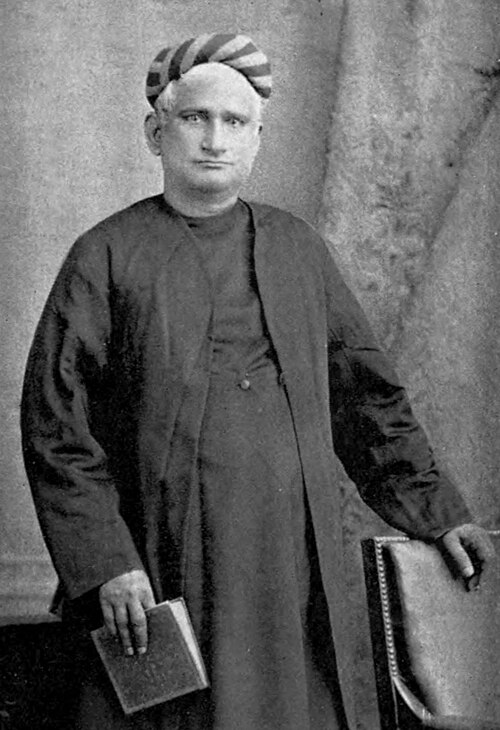
Bankim Chandra Chatterjee (Chattopadhyay) (1838–1894): The father of the modern Bengali novel. His seminal 1882 novel Anandamath popularized the song "Vande Mataram," which served as a major rallying cry during the independence movement. He was educated at Presidency College in Calcutta (Kolkata), and graduated with a degree in Arts in 1859. He also attended the University of Calcutta, and was among the school's first graduates. He later obtained a degree in law. Like Rammohun Roy, he served the British colonial government (1858-1891). Chatterjee's first published novel was Rajmohan's Wife, written in English. However, most of his output was in Bengali, starting with Durgesa Nandini (1865). While Bankim's first three novels were historical romances, he took a turn to contemporary realism with The Poison Tree, published in 1872-3 in Bengali and translated into English in 1884. The Poison Tree is essentially a melodramatic love triangle type narrative, but it points to social problems in Indian life -- issues such as polygamy and widow-remarriage (though Bankim appears to be opposed to widow-remarriage as leading to immorality). Our version of the translation is here; a detailed summary of the novel is here.- Bankim's novel Anandamath was a work of historical fiction, first published in Bengali in 1882, and originally translated as The Abbey of Bliss. Our version of the text is here.
- Our version of Bankim Chandra Chatterjee's first Bengali-language novel, Durgesa Nandini, translated into English in 1880, and published in Calcutta. Detailed summary here.
- Our version of Bankim Chandra Chatterjee's Kopal-Kundala, another in his series of historical romances, translated into English in 1885. Detailed summary here.
- Our version of Krishnakanta's Will (1878), translated into English in 1917. This is a "realist" novel set in the author's present day (to be sure, Bankim's form of realism contains many melodramatic elements). There is a detailed summary of the novel here. As with The Poison Tree, there are some allusions to a key social reform question of the day in the novel, specifically the question of widow remarriage.
- Our version of Chandra Shekhar (1875), translated into English 1905. This is a historical romance in the vein of Bankim's novels from the 1860s. It features an East India Company officer, Lawrence Foster as a villain -- but also shows his point of view. It also foregrounds the declining Mughal Empire, and has a subplot involving Mughal officials and a woman thought to be dishonored by her connection to the East India Company officer. Full text here; detailed summary here.
Toru Dutt (1856-1877) is not usually considered as a central figure in the Bengal Renaissance, in part because she and her sister spent much of their young adulthood outside of India. She also wrote in English and French rather than Bengali. Her major works are Sita, A Sheaf Gleaned in French Fields (1876), Bianca, or the Spanish Maiden (1878) and Ancient Ballads and Legends of Hindustan (published posthumously in 1882). She died at age 21 of tuberculosis. Our version of Ancient Ballads is here; our version of Bianca can be found here.
Rabindranath Tagore (Thakur) (1861–1941): A monumental figure of this era, he became Asia's first Nobel laureate in Literature in 1913. It is truly difficult to summarize his vast career in a few sentences, and readers are encouraged to look at the Wikipedia entry for a detailed biography. Tagore was the son of Debendranath Tagore, mentioned above as a co-founder of the Brahmo Samaj, a key figure in the Bengal Renaissance. Tagore had the benefit of several highly accomplished and ambitious siblings, including one brother who was a philosopher and poet, another who was a musician and playwright,another who was the first Indian appointed to the elite (and previously all-English) Indian Civil Service, and a sister who was herself a novelist. Tagore did study law briefly in England before dropping out, to engage in independent study of English literature. He began writing in earnest in the 1880s and 90s, publishing many short stories and books of poems during that fertile period.- In 1912, the English translation of Gitanjali piqued the interest of W.B. Yeats, who wrote a gushing preface; the critical acclaim led to Tagore receiving the Nobel Prize in Literature in 1913.
- We have versions of Gora and The Home and the World on this site, along with Tagore's influential lectures on the problem of nationalism and militarism here.
- We have also included a book of autobiographical essays, published as My Reminiscences, here.
- A volume of translated Tagore short stories, called Stories from Tagore, was published by Macmillan in 1918. An edition of the stories is here; our detailed summaries are here.
- Another volume of translated stories also appeared in 1918, Mashi and Other Stories. Our summaries of those stories, with generous inclusion of relevant quoted passages, can be found here.
- Tagore's first collection of short stories translated into English was The Hungry Stones and Other Stories (1916).
- Another volume of translated stories appeared in 1925 as Broken Ties and Other Stories (1925). See our detailed summaries of the stories in this collection here.
Sarat Chandra Chattopadhyay (1876–1938): One of the most popular Bengali novelists, known for works focusing on contemporary social realities, domestic life, and the plight of women. His novels have been especially popular for screen adaptations, with a long array of adaptations of his Devdas spanning essentially the entire history of Indian cinema. Another film that has an excellent recent adaptation is Parineeta. His nationalist novel, Pather Dabi (serialized in 1921; published in book form in 1926), was banned in British India for its seditious content.
See our version of his novel Srikanta (part 1) here; see a detailed summary of Srikanta here.
As mentioned, Pather Dabi was banned on publication, and remained untranslated until 1993. The novel is a passionate critique of the failures of the British justice system, and racial bias and discrimination against Indians in the British colonial hierarchy. The novel features a secret society and a charismatic revolutionary leader, Sabyasachi, who is building a revolutionary movement largely among expatriate communities (most of the novel is set among the Indian population in Rangoon, Burma). It also features a critique of patriarchal double-standards regarding the role of women in the revolutionary movement. The English translation is still under copyright, but see our detailed summary of Pather Dabi with select passages here.
-
1
2026-07-23T13:30:36+00:00
Rabindranath Tagore (1861-1941): Author Profile
6
Author Profile for Rabindranath Tagore (Thakur)
plain
2026-08-05T12:37:49+00:00
Rabindranath Tagore (Thakur) (1861–1941):
A monumental figure of this era, he became Asia's first Nobel laureate in Literature in 1913. It is truly difficult to summarize his vast career in a few sentences, and readers are encouraged to look at the Wikipedia entry for a detailed biography.
Tagore was the son of Debendranath Tagore, mentioned above as a co-founder of the Brahmo Samaj, a key figure in the Bengal Renaissance. Tagore had the benefit of several highly accomplished and ambitious siblings, including one brother who was a philosopher and poet, another who was a musician and playwright,another who was the first Indian appointed to the elite (and previously all-English) Indian Civil Service, and a sister who was herself a novelist.
Tagore's early education was largely informal; he did not do a conventional secondary school or college/university degree. Tagore did study law briefly in England before dropping out, to engage in independent study of English literature. He began writing in earnest in the 1880s and 90s, publishing many short stories and books of poems during that fertile period (sometimes referred to as the "Sadhana" period, after the magazine that was published by the Tagore family). His biographers Krishna Dutta and Andrew Robinson identify the 1890 collection of poetry he published just after returning from England, Manasi (or Manashi) as being an especially important breakthrough for his own career and for Bengali-language literature.
Tagore was born and raised in Calcutta (Kolkata), but in the 1890s he was living primarily at his family's country estate at Shelaidaha (then usually called "Shelidah" in English), in what is today Bangladesh. There, he performed landlord duties on his family's behalf, receiving payments from tenants, addressing complaints, and managing the estate. He is described by his biographers Krishna Dutta and Andrew Robinson as finding the experience of country life and ordinary people as an eye-opening experience, and the decade he spent living and working at Shelaidaha as one of the most fruitful ones for him of his entire career. Not surprisingly, many of the stories he wrote during this period play on what might be described as "country vs. city" themes, exploring the gap between urban and rural life, and the clash between traditional Bengali peasant life and modern, colonial India. Also, even as he was outside of Calcutta while writing most of these stories, many of the stories do engage with city living in Calcutta in interesting ways. Others are written from the point of view of Landlords (Zemindars) like himself.
After 1901, Tagore left Shelaidaha and began developing his school at Shantiniketan. He also shifted towards novel-writing, with books like Nastanirh (1901) and Chokher Bali (1902). In the 1910s, he came to the attention of the English-speaking world as translations of many of his important works began appearing.- We are collecting all of the Tagore short stories that we can find under a single 'path', with bibliographic information here.
- In 1912, the English translation of Gitanjali piqued the interest of W.B. Yeats, who wrote a gushing preface; the critical acclaim led to Tagore receiving the Nobel Prize in Literature in 1913.
- We have versions of Gora and The Home and the World in English translation on this site, along with Tagore's influential lectures on the problem of nationalism and militarism here.
- We have also included a book of autobiographical essays, published as My Reminiscences, here.
- A volume of translated Tagore short stories, called Stories from Tagore, was published by Macmillan in 1918. An edition of the stories is here; our detailed summaries are here.
- Another volume of translated stories also appeared in 1918, Mashi and Other Stories. Our summaries of those stories, with generous inclusion of relevant quoted passages, can be found here.
- Tagore's first collection of short stories translated into English in the West was The Hungry Stones and Other Stories (1916).
- Another volume of translated stories appeared in 1925 as Broken Ties and Other Stories (1925). See our detailed summaries of the stories in this collection here.
- There was also a volume of Tagore short stories published in translation in Calcutta in 1913, Glimpses of Bengal Life.
- The English translation of Gitanjali, with a preface by W.B. Yeats, is here.