Asian American Women
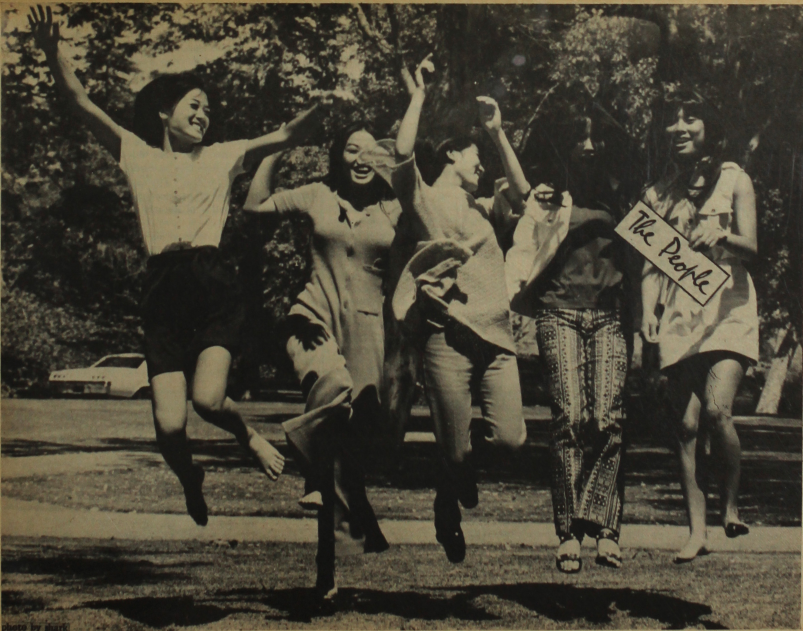
1 2019-07-10T11:55:01+00:00 Amardeep Singh c185e79df2fca428277052b90841c4aba30044e1 165 1 Photo of Asian American Women Leaping Into the Air from Gidra 1.5 plain 2019-07-10T11:55:01+00:00 Amardeep Singh c185e79df2fca428277052b90841c4aba30044e1This page is referenced by:
-
1
2019-07-04T08:56:19+00:00
Gidra Magazine (1969-1974; Los Angeles)
15
Gidra Magazine
plain
2019-07-23T11:06:23+00:00
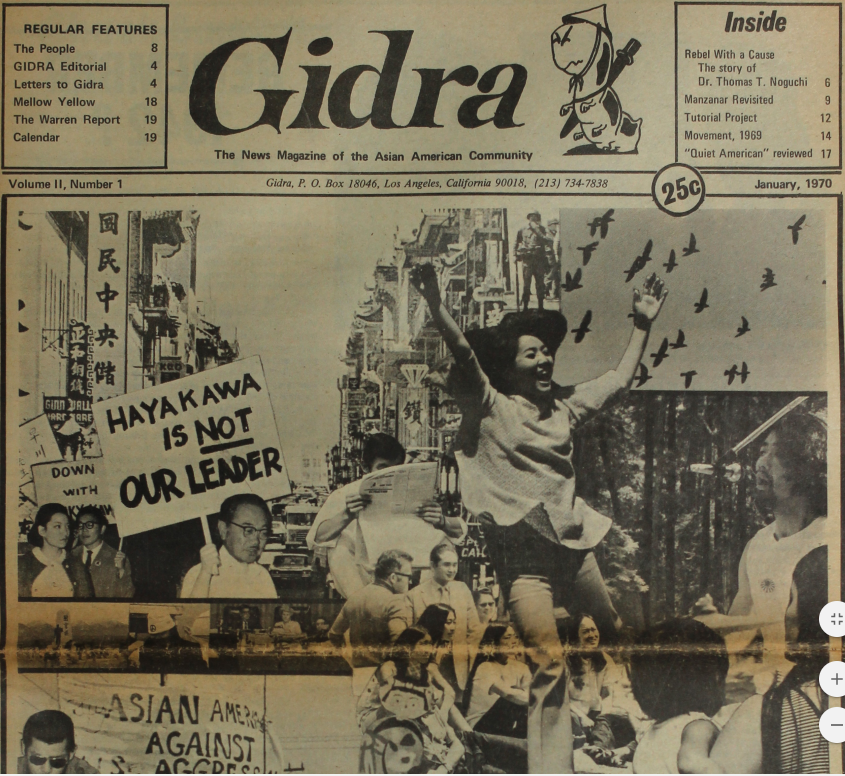
Gidra: The Monthly of the Asian American Experience, was a Los Angeles-based monthly that ran from 1969-1974. Given the range of topics covered and the pedigree of its authors and editors, Gidra might be the single most influential Asian American little magazine. A number of articles first published in Gidra were later re-published in other venues, including Roots: An Asian American Reader. Figures who would later be influential in California politics, including Warren Furutani and Mike Murase, had their start at Gidra, as did influential poets like Amy Uyematsu.
Gidra was created by a group of students at the University of California, Los Angeles. Its early issues cover the first course on Asian American identity taught at UCLA, "Orientals in America" (issue 1-2; the course was taught by Yuji Ichioka), as well as the founding of the Asian American Student Alliance (issue 1-3). Other topics covered in the first few issues include the reaction of S.I. Hayakawa to Gidra itself (he was dismissive), as well as the trial of Dr. Thomas Noguchi.
A breakthrough of sorts might be found in Gidra 1.5 (August 1969). This issue contains a series of detailed explorations of Asian American identity through historical essays looking at the experiences of Japanese Americans, Korean Americans, Chinese Americans, and Filipino Americans. It also contains an extensive list of community organizations. The strong historical focus and the emphasis on the emerging pan-ethnic networks suggests a shift in the magazine's orientation -- from an emphasis on provocation to a focus on community development.
William Wei recognizes the importance of Gidra in his book The Asian American Movement:
Wei describes Gidra as experiencing two phases, one roughly 1969-1971, the second from mid-1971 to 1974:Founded during the 1960s, Gidra was considered by some people to be the journalistic arm of the Movement. In a survey of Asian American periodicals, Rocky Chin noted that 'if there is an 'Asian-American Movement' publication, it is Gidra, the most widely circulated Asian American newspaper-magazine in the country." (Wei 103)
The first phase focused on the Movement, the issue of identity, and Asian American Studies programs. Activists accused colleges and universities of institutional racism, of contributing to the widespread ignorance and misconceptions about Asian Americans, and of facilitating the assimilation of a few individuals while abandoning the rest to poverty and isolation, a pernicious process that exacerbated problems afflicting Asian American communities. Gidra had a symbiotic relationship with one of the most prominent of these programs, the Asian American Studies Center at UCLA. During its first year, it published many articles about the Center and other Asian American Studies programs, as well as the need to make the educational system more responsive to the needs of Asian Americans. (Wei 106-107)
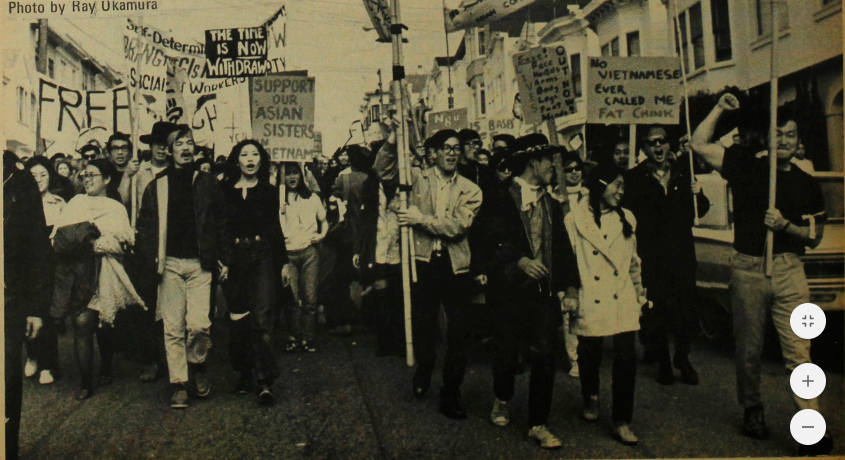
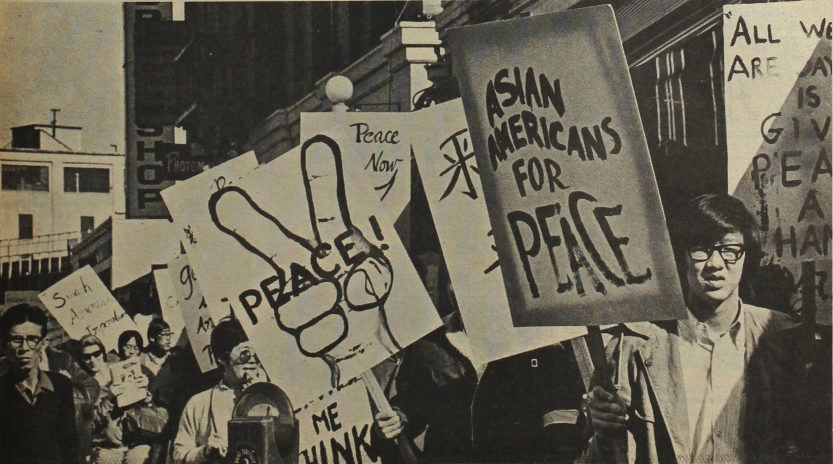
As the Vietnam War dragged on, and as the first group of editors phased out, the magazine increasingly developed a global perspective:During the second phase, Gidra developed more of an 'international perspective on the Asian American experience, attempting to place it within a larger political context. Here again, Asian American antiwar activists asserted that racial injustices at home were connected to imperialism aborad: To understand the former, one had to understand the latter. A reflection of this international perspective was stories about Japan and China. Given the predominance of Japanese American staffers and contributors, it was natural for them to be personally interested in Japan; but their stories, less than flattering to the land of their ancestors, focused on its dependence on the United States. (111)
The entire run of Gidra is available online at Densho Repository.
More links:
An introduction to Gidra by Brian Niiya at Densho Digital Repository.
An overview of Gidra by Jaeah J. Lee, with recent interview material from editor Mike Murase.