African American Poetry: A Digital Anthology

Langston Hughes, "The Weary Blues" (full text) (1926)

Page

resourcerdf:resourcehttps://scalar.lehigh.edu/african-american-poetry-a-digital-anthology/the-weary-blues-by-langston-hughes-1926
typerdf:typehttp://scalar.usc.edu/2012/01/scalar-ns#Composite
is livescalar:isLive1
was attributed toprov:wasAttributedTohttps://scalar.lehigh.edu/african-american-poetry-a-digital-anthology/users/48
createddcterms:created2022-01-05T15:17:55+00:00

Version 12

resourcerdf:resourcehttps://scalar.lehigh.edu/african-american-poetry-a-digital-anthology/the-weary-blues-by-langston-hughes-1926.12
versionnumberov:versionnumber12
titledcterms:titleLangston Hughes, "The Weary Blues" (full text) (1926)
contentsioc:contentEditor's Note: 

The Weary Blues is Langston Hughes' first published book of poetry. It was published by Knopf in 1926, with a preface by Carl Van Vechten. Alongside Alain Locke's anthology, The New Negro: an Interpretation (1925), the publication of Hughes' collection of poems is one of the defining moments of the Harlem Renaissance. The Weary Blues contains several of Hughes' best known poems, including "The Negro Speaks of Rivers," "Dream Variation," and the Epilogue ("I, too, sing America..."). It celebrates the emerging Black expressive culture in Harlem, but also reflects Hughes' considerable travels in the early 1920s, in Mexico, Europe, and the Caribbean (see "Water-front Streets," "A Farewell," "Port Town," "Natcha," "Soledad: A Cuban Portrait" and "Mexican Market Woman" for more of Hughes' internationalism).

Critics such as Arnold Rampersad have particularly singled out Hughes' innovative embrace of concepts borrowed from jazz and blues music as the defining innovation of this collection. The blues in particular would be central to Hughes' second published book of poems, Fine Clothes to the Jew (1928). Here, Hughes' interest in the collection seems equally divided between the blues theme and concepts and experiences closer to Jazz (along those lines, see "Jazzonia," "Negro Dancers," "To Midnight Nan at Leroys" and "The Cat and the Saxophone," to name just a few)

Langston Hughes first began publishing his poetry in The Crisis in June 1921; his first poem published there, fittingly, was "The Negro Speaks of Rivers," one of his most famous and enduring works. However, Hughes also published many other poems that would appear in The Weary Blues in magazines like Opportunity and Survey Graphic in the years leading up to the publication of his first book. 

For more on Langston Hughes, see our detailed timeline and Author Bio here. It features a timeline marking Hughes' various publications through the mid-1920s. 

This text was produced using the scanned version of the first edition of the book available at Google Books. For this digital edition, I extracted a plain text version, and then formatted and tagged the poems in the Table of Contents below. The plain text version can be found here.

--Amardeep Singh, Lehigh University. January 2022
--------------------


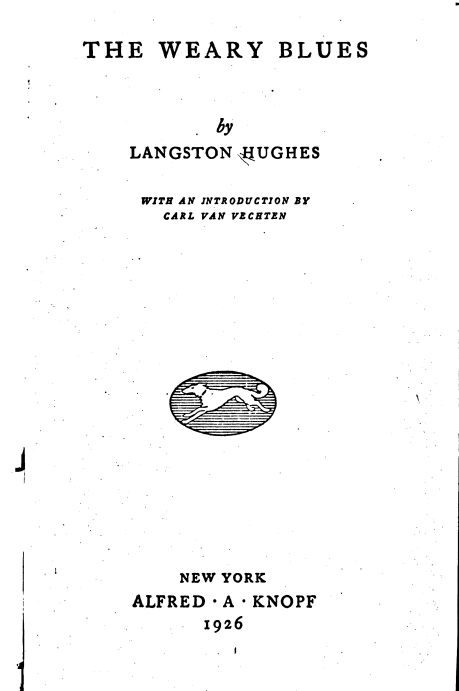
The Weary Blues
by Langston Hughes

With an Introduction by Carl Van  Vechten

New York: Alfred A. Knopf
1926

---------------------
Dedication: "To my mother"
---------------------
"I wish to thank the editors of The Crisis, Opportunity, Survey Graphic, Vanity Fair, The World Tomorrow and The Amsterdam News for having published some of the poems in this book."
default viewscalar:defaultViewplain
was attributed toprov:wasAttributedTohttps://scalar.lehigh.edu/african-american-poetry-a-digital-anthology/users/48
createddcterms:created2024-02-10T07:34:48+00:00
typerdf:typehttp://scalar.usc.edu/2012/01/scalar-ns#Version

This page has paths:

  1. Langston Hughes: Poems, Biography, and Timeline of his early career Amardeep Singh

Contents of this path:

  1. Introducing Langston Hughes to the Reader (Carl Van Vechten)
  2. Langston Hughes, "Proem" ["The Negro"] (1922)
  3. Langston Hughes, "The Weary Blues" (1925)
  4. Langston Hughes, "Jazzonia" (1923)
  5. Langston Hughes, "Negro Dancers" (1925)
  6. Langston Hughes, "The Cat and the Saxophone" (1925)
  7. Langston Hughes, "Young Singer" (1923)
  8. Langston Hughes, "Cabaret" (1923)
  9. Langston Hughes, "To Midnight Nan at Leroy's" (1926)
  10. Langston Hughes, "To a Little Lover-Lass, Dead" (1926)
  11. Langston Hughes, "Harlem Night Club" (1926)
  12. Langston Hughes, "Nude Young Dancer" (1926)
  13. Langston Hughes, "Young Prostitute" (1923)
  14. Langston Hughes, "To a Black Dancer in 'The Little Savoy'" (1926)
  15. Langston Hughes, "Song for a Banjo Dance" (1922)
  16. Langston Hughes, "Blues Fantasy" (1926)
  17. Langston Hughes, "Lenox Avenue: Midnight" (1926)
  18. Langston Hughes, "Dream Variation" (1924)
  19. Langston Hughes, "Winter Moon" (1923)
  20. Langston Hughes, "Poeme d'Automne" (1926)
  21. Langston Hughes, "Fantasy in Purple" (1926)
  22. Langston Hughes, "March Moon" (1926)
  23. Langston Hughes, "Joy" (1926)
  24. Langston Hughes, "The Negro Speaks of Rivers" (1921)
  25. Langston Hughes, "Cross" (1925)
  26. Langston Hughes, "The Jester" (1926)
  27. Langston Hughes, "The South" (1926)
  28. Langston Hughes, "As I Grew Older" (1926)
  29. Langston Hughes, "Aunt Sue's Stories" (1921)
  30. Langston Hughes, "Poem" ("The Night is Beautiful...") (1923)
  31. Langston Hughes, "A Black Pierrot" (1926)
  32. Langston Hughes, "Harlem Night Song" (1926)
  33. Langston Hughes, "Songs to the Dark Virgin" (1926)
  34. Langston Hughes, "Ardella" (1926)
  35. Langston Hughes, "To the Black Beloved" (1925)
  36. Langston Hughes, "When Sue Wears Red" (1920/1923)
  37. Langston Hughes, "Pierrot" (1926)
  38. Langston Hughes, "Water-Front Streets" (1926)
  39. Langston Hughes, "A Farewell" (1926)
  40. Langston Hughes, "Long Trip" (1926)
  41. Langston Hughes, "Port Town" (1926)
  42. Langston Hughes, "Sea Calm" (1926)
  43. Langston Hughes, "Caribbean Sunset" (1926)
  44. Langston Hughes, "Young Sailor" (1926)
  45. Langston Hughes, "Seascape" (1926)
  46. Langston Hughes, "Natcha" (1926)
  47. Langston Hughes, "Sea Charm" (1925)
  48. Langston Hughes, "Death of an Old Seaman " (1926)
  49. Langston Hughes, "Beggar Boy" (1926)
  50. Langston Hughes, "Troubled Woman" (1926)
  51. Langston Hughes, "Suicide's Note" (1926)
  52. Langston Hughes, "Sick Room" (1926)
  53. Langston Hughes, "Soledad: A Cuban Portrait" (1925)
  54. Langston Hughes, "To the Dark Mercedes of 'El Palacio de Amor'" (1926)
  55. Langston Hughes, "Mexican Market Woman" (1926)
  56. Langston Hughes, "After Many Springs" (1926)
  57. Langston Hughes, "Young Bride" (1925)
  58. Langston Hughes, "The Dream Keeper" (1925)
  59. Langston Hughes, "Poem (To F.S.)" (1925)
  60. Langston Hughes, "Our Land (Poem for a Decorative Panel)" (1923)
  61. Langston Hughes, "Lament for Dark Peoples" (1924)
  62. Langston Hughes, "Afraid" (1926)
  63. Langston Hughes, "Poem: For the portrait of an African boy after the manner of Gauguin"
  64. Langston Hughes, "Summer Night" (1925)
  65. Langston Hughes, "Disillusion" (1925)
  66. Langston Hughes, "Danse Africaine" (1926)
  67. Langston Hughes, "The White Ones" (1924)
  68. Langston Hughes, "Mother to Son" (1922)
  69. Langston Hughes, "Poem ["We Have Tomorrow..."]" (1926)
  70. Langston Hughes, "I , Too" (1925)

This page references: