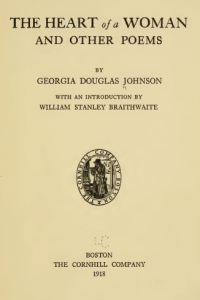
"The Heart of a Woman and Other Poems" by Georgia Douglas Johnson (1918)
Georgia Douglas Johnson was born in Atlanta, Georgia, possibly in 1880*. She was raised in a middle-class African American household and graduated from Atlanta University's Normal School in 1896. She also attended the Oberlin Conservatory of Music outside of Cleveland, Ohio, where, according to Hull she studied "music, harmony, violin, piano, and voice."
In 1903, Johnson married a man named Henry Lincoln Johnson, a lawyer in Atlanta, and they had two sons. In 1910, Henry Johnson was hired by the Taft administration to serve as Reorder of Deeds, and the couple settled in Washington, DC. Their home (referred to by biographers and critics as the "S Street Salon") would become an important site in the emerging African American literary and arts community on the east coast of the U.S.
Johnson published four volumes of poetry, of which we intend to digitize two, The Heart of a Woman (1918), and Bronze (1922). The poems in The Heart of a Woman are largely apolitical; Johnson wrote them under the influence of prominent African American critic William Stanley Braithwaite, who encouraged his peers to aim for refinement and lyricism rather than political engagement or race-consciousness. Braithwaite also wrote the introduction to the collection and praised them for these qualities: "The poems in this book are intensely feminine and for me this means more than anything else that they are deeply human."
By contrast, the poems in Bronze are explicitly focused on issues of gender and racial justice. Johnson herself was self-conscious about this change in emphasis, and wrote a letter to fellow-poet Arna Bontemps in 1941 where she contrasted the two books:
My first book was The Heart of a Woman. It was not at all race conscious. Then some one said--she has no feeling for the race. So I wrote Bronze--it is entirely racial and one section deals entirely with motherhood--that motherhood that has as its basic note--black children born to the world's displeasure. (cited in Hull, 160)
Some of the most powerful include, "Black Woman," first published in The Crisis as "Motherhood." Another poem foregrounding the fraught nature of motherhood in light of racism is "One of the Least of These, My Little One."
In 1925, four poems by Johnson were included in Alain Locke's anthology, The New Negro: an Interpretation (the four poems were "To Samuel Coleridge Taylor, Upon Hearing His," "The Ordeal," "Escape," and "The Riddle"). Since Locke's anthology became one of the defining publications of the era, her inclusion in that anthology (alongside Arna Bontemps, Anne Spencer, and Angelina Grimke) helped establish her as one of the key figures of the Harlem Renaissance. (For more on the periodization and definition of the Harlem Renaissance, click here). Claudia Tate, in her introduction to The Selected Works of Georgia Douglas Johnson (1997), refers to Johnson as "the most anthologized woman poet of the New Negro Renaissance" (xviii).
For a Works Cited, see the site Bibliography.
* There is some debate about when Johnson might have been born. Gloria Hull gives the date as September 10, 1880, but Venetria Patton and Maureen Honey give the date as 1877. Early in her career, Georgia Douglas Johnson gave her own date of birth to editors and peers as 1886.
Contents of this path:
- Introduction to "The Heart of a Woman" by William Stanley Braithwaite
- The Heart of a Woman
- Gossamer
- The Dreams of the Dreamer
- Sympathy
- Contemplation
- Dead Leaves
- Dawn
- Elevation
- Whither?
- Quest
- Mate
- Emblems
- Mirrored
- Pent
- Pages from Life
- Recall
- Foredoom
- Peace
- Despair
- Eventide
- Gethsemane
- Gilead
- Impelled
- In Quest
- Inevitably
- Isolation
- Joy
- Memory
- Modulations
- Omega
- Poetry
- Posthumous
- Query
- Recompense
- Repulse
- Rhythm
- Smothered Fires
- Supreme
- Sympathy
- Tears and Kisses
- The Measure
- Thrall
- Tired
- What Need Have I For Memory?
- When I Am Dead
- Whene'er I Lift My Eyes to Bliss
- Where?
- Youth